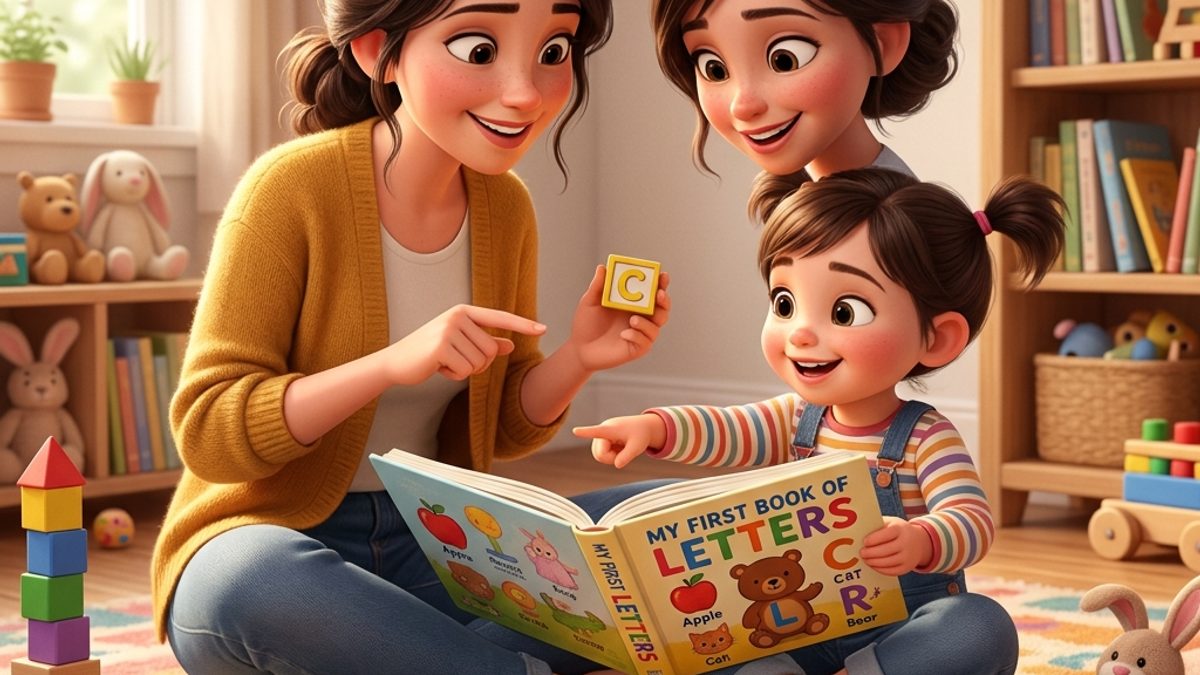
For many parents, teaching a young child to read feels fraught with anxiety. Should you buy stacks of sight-word flashcards? Should you let them memorize repetitive leveled readers? Or should you wait until kindergarten and hope the school system handles it?
Decades of cognitive neuroscience and the landmark findings of the Science of Reading have settled the debate once and for all: the human brain learns to read through systematic synthetic phonics—not through memorizing word shapes or guessing from picture clues.
Teaching phonics at home does not require expensive curriculum kits or drill-sergeant flashcard sessions. In fact, when approached through joyful sound play and shared storytelling, early phonemic awareness becomes a natural, bonding adventure.
Here is what neuroscience reveals about how children learn to read, along with a closed-ended 4-step blueprint you can practice in 10 minutes tonight.
"The human brain is not biologically pre-wired to read as it is to speak; it must recycle visual cortex neurons to recognize letter combinations and map them onto auditory phonemes. Explicit, systematic phonics is the only instruction that honors the true neurobiology of the brain."
— Dr. Stanislas Dehaene, Cognitive Neuroscientist and Author of Reading in the Brain
Higher long-term reading fluency in children taught systematic synthetic phonics
vs. whole-word memorization / balanced literacy guessing strategies
Why Phonics Works: The Cognitive Architecture of Reading #
Unlike spoken language, which evolved over hundreds of thousands of years, reading was invented just 5,000 years ago. Every child must manually wire together three distinct brain regions:
- The Visual Form Area ("The Brain's Letterbox"): Located in the left occipital-temporal lobe, this region learns to recognize visual letter shapes (graphemes like b, m, s).
- The Phonological Processor: Located near the ear, this area identifies speech sounds (phonemes like /b/, /m/, /s/).
- The Semantic Network: Connects the blended sound to its real-world meaning ("A brown bear that roars").
When children are encouraged to guess words based on pictures (the outdated "three-cueing" method), they bypass the letterbox entirely, building fragile reading habits that collapse in late elementary school.
Sturdy Warmth: Teaching Phonics Without Stress #
Parents often fall into two traps: the authoritarian drill-master (demanding 30 minutes of flashcards, causing tears) or the permissive abandoner (giving up at the first sign of struggle).
The balanced sturdy warmth approach provides calm, steady encouragement while keeping sessions brief, predictable, and stress-free:
| Parenting Approach | Reaction to Reading Struggle | Long-Term Impact |
|---|---|---|
| Authoritarian (Hard) | "Sound it out! You knew this word yesterday! Focus!" | Child develops reading anxiety and emotional avoidance |
| Permissive (Soft) | "It's okay, you don't have to try. Let's just watch TV." | Child internalizes that challenges mean inability |
| Sturdy Warmth (Balanced) | "That was a tough sound! Let's stretch it out together: /s/ - /u/ - /n/. You've got this." | Child builds grit, self-confidence, and neural resilience |
"When a child feels anxious, their prefrontal cortex goes offline, making working memory inaccessible. High warmth and zero-judgment practice is not just gentle parenting—it is a neurological prerequisite for learning."
— Dr. Becky Kennedy, Clinical Psychologist and Author of Good Inside
The 4-Step Phonics Blueprint: 10 Minutes a Day #
Keep home phonics practice short, lively, and predictable. Follow this sequence:
Step 1: Teach Pure Sounds, Not Letter Names #
When introducing the alphabet, teach the sound the letter makes first. Letter names can be confusing (e.g., the letter name "W" sounds like "double-u", which has nothing to do with the sound /w/):
- Teach continuous sounds first: m (/mmmm/), s (/ssss/), f (/ffff/).
- Avoid adding the "schwa" sound (say /m/, not "muh").
Step 2: Play "Secret Agent" Oral Blending #
Before reading letters on a page, practice blending sounds in the air during car rides or snack time:
- Parent says: "Can you touch your /l/ - /e/ - /g/?"
- Child blends: "Leg!"
- Parent says: "Time to put on your /h/ - /a/ - /t/!"
- Child blends: "Hat!"
Step 3: Build 3-Letter CVC Words (Consonant-Vowel-Consonant) #
Use magnetic letters or write on index cards. Lay out simple, phonetically regular words:
- c - a - t → cat
- s - u - n → sun
- Run your finger smoothly beneath the letters as you blend the sounds: /ssss/ - /uuuu/ - /nnnn/ → sun!
Step 4: Shared Dialogic Reading with Narrated Books #
Follow along in illustrated storybooks where clear, professional audio narration models pristine articulation.
- Point to repeating words as they are spoken.
- In Fabella's interactive storybooks, synchronized narration lets your child see and hear words in rich story contexts without academic pressure.
[!TIP] Recommended Deep-Dive: If you are exploring this topic, read our clinical guide on The Science of Dad Roughhousing: Why Rough Play Builds EQ for proven scripts and routines.
Build Reading Confidence with Fabella #
Early literacy should feel like a celebration of curiosity, not a chore. The Fabella Interactive Library is designed to support growing readers with:
- Clear Audio Cadence: Expert human-like narration that highlights natural phonological rhythm.
- Synchronized Visual Flow: Helps developing eyes track text from left to right smoothly.
- Warm, Whimsical Worlds: Keeps children deeply engaged in characters and storylines.
Unlock the joy of reading for your preschooler today. Explore our Free Interactive Storybook Library and start your 10-minute phonics journey tonight!